
The shared responsibility model is a framework that clearly defines the scope of responsibility between service providers and users in cloud services. Based on the principles of the AWS (Amazon Web Services) shared responsibility model, Shifter defines a two-tiered division of responsibility tailored to its WordPress static site hosting service.
This document clarifies the areas managed by Shifter and those managed by the customer, and explains the scope of support and service levels.
Definition of Responsibilities
Shifter’s Shared Responsibility Model consists of the following two-tier structure:
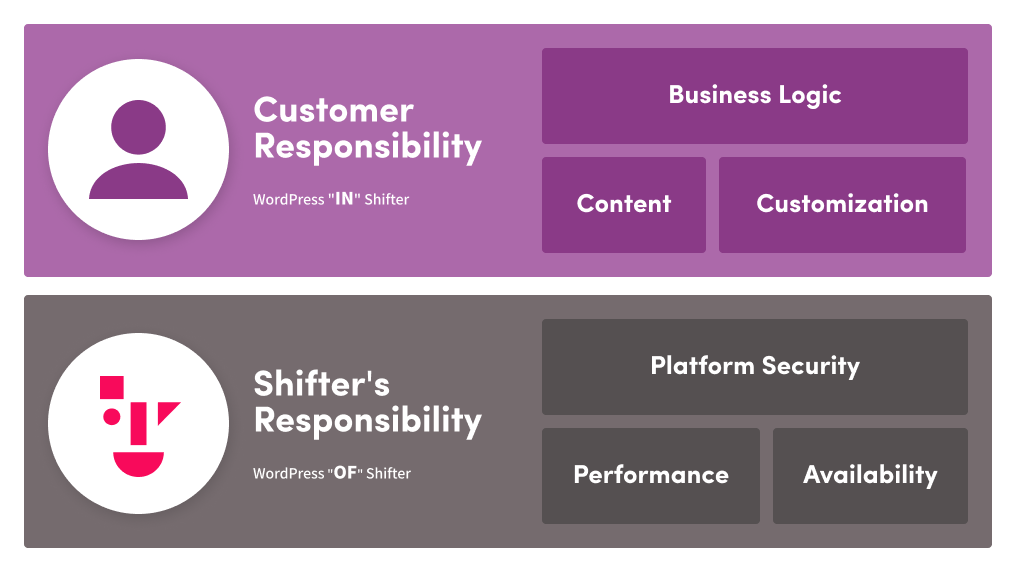
Tier 1: Shifter’s Scope of Responsibility (WordPress “OF” Shifter)
This is the area managed and operated by Shifter as the platform provider. Customers cannot access or manage these elements.
Layer 2: Customer’s Scope of Responsibility (WordPress “IN” Shifter)
This is the area managed and operated by the customer as a platform user. It includes elements under the customer’s control, such as content, settings, and customizations.
Shared Responsibility Matrix
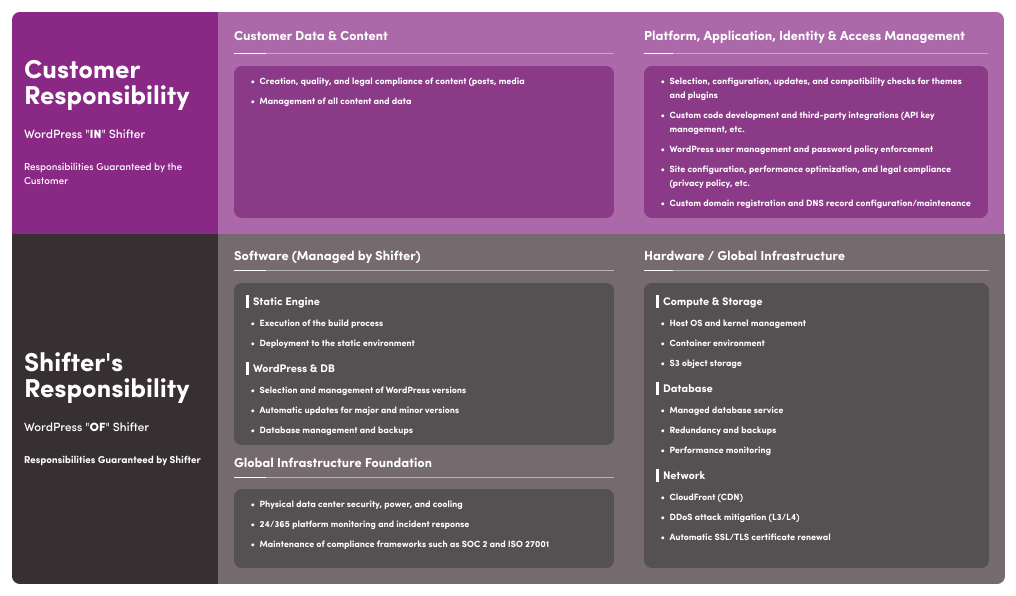
Shifter’s Scope of Responsibility
| Category | Specific Details |
| Infrastructure | Management and operation of servers, networks, storage, and CDN (CloudFront) |
| Platform | Management and updates of the host OS, container environment, PHP runtime, and web server |
| WordPress Runtime Environment | Version management of WordPress core, automatic application of security patches, implementation of major version upgrades, and database management |
| Staticization Engine | Execution of the build process, management of the build queue, deployment, and logging of build error logs |
| Backup | Generation of backups during the build process, management of build file history, and data recovery in the event of a platform failure |
| Security Infrastructure | Platform vulnerability scanning; detection and mitigation of DDoS attacks; automatic issuance and renewal of SSL/TLS certificates (for standard and custom domains) |
Customer Responsibilities
| Category | Specific Details |
| WordPress Configuration | General settings such as site title, time zone, permalink structure, language, media settings, and display settings |
| Themes | Theme selection, theme configuration (Customizer, widgets, menus), theme customization (CSS, template file editing), determining the timing of theme updates, and prior verification of compatibility with staticization |
| Plugins | Plugin selection, plugin configuration, determining the timing of plugin updates, resolving conflicts between plugins, and prior verification of compatibility with staticization |
| Content | Creating, editing, and deleting posts, pages, and media; content quality control; ensuring content compliance (copyright, privacy laws, defamation prevention); designing dynamic features for staticization |
| Custom Code | Development of custom CSS, JavaScript, and PHP; code debugging, correction, and testing |
| External Service Integration | Acquiring and managing API keys for HubSpot, Algolia, Shopify, Stripe, and others; implementing integrations with external services; data synchronization and error handling |
| User Management | Adding and removing WordPress users; assigning roles; password management; enabling two-factor authentication; configuring access permissions |
| Performance Optimization | Image optimization (format selection, resizing, lazy loading), use of external video hosting, removal of unused CSS/JS, management of third-party scripts, and meeting performance metrics such as Core Web Vitals |
| Custom Domain/SSL Certificate | Registering a custom domain with Shifter; configuring and maintaining DNS records for domain ownership verification; configuring and maintaining DNS records (e.g., CNAME) for SSL certificate verification; modifying the domain’s DNS settings |
| Data Protection | Ownership and management of all content and data; maintaining independent backups of critical data; testing restoration from backups |
| Compliance | Drafting and publishing a privacy policy; notifying users about cookie usage and obtaining consent; complying with laws such as the Personal Information Protection Act and GDPR; complying with industry-specific regulations |
Note: Shifter manages infrastructure-level performance (CDN speed, server response time), but ultimate site performance (Core Web Vitals, etc.) depends on the quality of your content and code.
Note: While Shifter provides a technical security foundation and compliance certifications, the assessment and implementation of legal compliance for your business remain your responsibility.
Scope of Support
Scope of Free Support
We will address issues falling within Shifter’s scope of responsibility free of charge.
| Types of Issues | Support Provided |
| Platform Outages | Inability to access the dashboard, authentication system failures, infrastructure failures |
| Build Engine Malfunctions | Errors in the build process caused by Shifter |
| CDN Delivery Issues | Delivery failures from CloudFront, SSL certificate errors for Shifter standard domains (*.on.getshifter.io) |
| Backup Failures | Failure to execute automatic backups |
Paid Support Scope
We provide advice and guidance regarding matters within the customer’s scope of responsibility. This does not include implementation work, writing code, or performing configuration tasks on the customer’s behalf.
| Type of Issue | Support Provided (Advice Only) | Not Covered (Implementation Work) |
| Investigation of build failures | Basic information, Shifter documentation, guidance on how to investigate WordPress error logs, recommendations for alternative plugins, and investigation of build process failures | Plugin configuration Code modifications |
| Plugins | Basic information, Shifter documentation, and official WordPress documentation | Re-configuring the plugin Implementing customizations |
| Theme customization | Basic information, Shifter documentation, and official WordPress documentation | Writing CSS Editing template files |
| WordPress settings | Basic information, Shifter documentation, and official WordPress documentation | Implementation of configuration and optimization tasks on your behalf |
| Performance optimization | Basic information, Shifter documentation, and official WordPress documentation | Image optimization and code minification Identification of bottlenecks and proposal of improvement measures |
| Custom domain/SSL certificate | Basic information, Shifter documentation, and official WordPress documentation | DNS Configuration on Your Behalf Tasks at the Domain Registrar |
| Content Migration | Basic information, Shifter documentation, official WordPress documentation, and recommended tools | Execution of Migration Tasks Data Cleaning |
Out of Scope
The following items are out of scope for all plans:
- Debugging and Fixing Custom Code
- WordPress Basic Usage Courses and Training
- Design Services
- Content Creation and Writing Services
- SEO Consulting
- Web Analytics and Marketing Strategies
- Full Support for Third-Party Products (Plugins, Themes)
- Support for External Services (HubSpot, Algolia, etc.)
Note: Regarding Open-Source Software Published by Our Company
DigitalCube releases open-source software related to WordPress and Shifter under licenses such as the GPL or MIT. These are provided “as is” without warranty, in accordance with the license terms. While the operation of these OSS components as features integrated into the Shifter service is covered by the support scope outlined above, technical support for the use of the OSS on its own is not included.To report bugs or request feature improvements, please use the Issues section of the respective GitHub repositories.